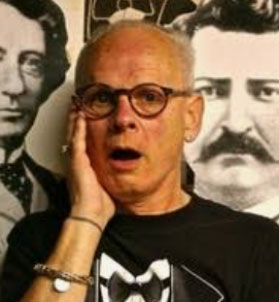

WWG is back from our summer hiatus! Opening Saturday, September 12, 6 – 9 pm, at the gallery space (159 Main Street East, North Bay, ON) is What We Make of the Dark, works in mixed media by Schem Rogerson Bader (Toronto, ON) and Terre Chartrand (Southampton, ON.)
These works are created to explore loss and grief. Bader treats disillusion not as an endpoint, but as a condition produced by late capitalism. Images, bodies, and objects circulate through cycles of production, use, abandonment, and return. Modernity’s false promise of progress and its failure to deliver are wounds we live with. Exploitation and violence are implicit in advantage. These cycles are entangled: care and depletion, and rhythms of attachment and discard.
The artists will be on site for the reception to hold a grief tea dance, where attendees are invited to join in as we honour the history and modernity of loss through a queer lens.
Schem Bader (they/them) is a multidisciplinary artist working across mixed media to explore grief, ecological loss, and the affective conditions of late capitalism. Bader holds a Ph.D. in Communication & Culture from York University and Toronto Metropolitan University, an M.F.A. in Photography and Related Media from the School of Visual Arts (New York), and a B.F.A. in Drawing and Painting from OCAD University (Toronto). Recent exhibitions include The Disappearance of Aesthetics, Gagné Contemporary (2026); Nuit Rose, Youngplace (2026); Wild Waysides: Queer Ecology and the New Natural (2025–26), a travelling exhibition developed from Queer Up North, Temagami; FaultLines at Gagné Projects (November 2024); and other tongues part I: communication at Onsite Gallery (June 2024). Bader has participated in residencies including Queer Up North (Temagami) and Making/Thinking (Catskills).
Terre Chartrand, an Indigequeer Omámi Ininiwak (Algonquin), French, and Welsh artist, brings a background in literature, theatre, visual arts, photography, technology, game design, and science. As the founder and artistic director of various collectives and projects,
Terre is the founder of Red Osier Guild – a guild for land based learning, cultural resurgence, and survival, she initiated Pins and Needles Fabric Company, an inter-arts collective, founded the urban Indigenous youth arts collective Endaayaang – Our Home, and was the
designer and a co-founder of O:se Kenhionhata:tie #LandBackCamp, a culture and Land Back camp for Two-Spirit youth. Current projects focus on relationship to the land, land restoration, survivance, and land based learning.